Maybe read the title of the thread. But if this discussion about PCVs
has to be had for the 35,000th time:
https://help.summitracing.com/app/an...cv-valve-do%3F
Quote:
What does it do?
The PCV valve serves a few purposes:
1)It stops excessive amounts of oil from being drawn out of the crankcase.
2)It regulates the amount of Vacuum applied to the crankcase.
2A)At low rpm, when vacuum is high, the valve closes slightly to reduce airflow.
2B)At higher rpm, when vacuum is less, the valve opens more to increase airflow.
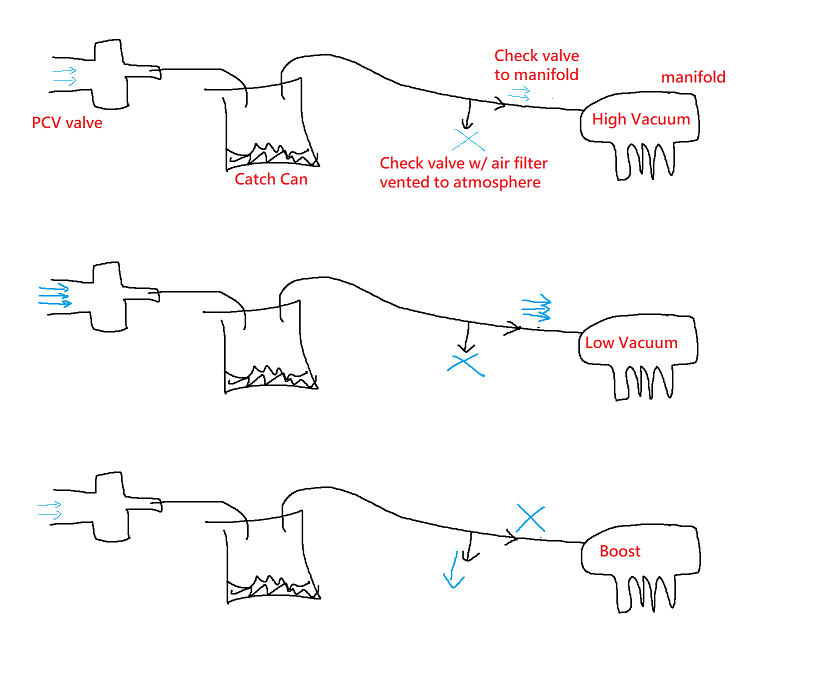
3)It acts as a 1-way check valve for forced induction or a backfire. It won't allow the crankcase to be pressurized.
A diagram of a PCV valve working at low rpm, high rpm, and a backfire.

How does it affect performance?
The PCV valve controls your PCV System. Follow your maintenance schedule and make sure the valve and The PCV Hoses stay clean and clear. This will extend the life of your oil and the engine itself.
The PCV system also helps the engine make a little more power. The slight vacuum in the crankcase improves the seal of the piston rings and valve stems. This keeps the compression in the chamber, where we want it. A PCV system also reduces windage and oil aeration. These cause drag on the rotating assembly and rob you of some power.
|
http://www.hastingsfilter.com/Literature/TSB/94-2R1.pdf
Quote:
Blow-by gases and vapor should be removed at about the same rate they enter
the crankcase. Since blow-by is minimal at idle and increases during high speed
operation, the PCV valve must control the flow of vapor accordingly. The PCV
valve is designed to compensate for the engine ventilation needs at varying
engine speeds. It is operated by manifold vacuum which increases or decreases
as engine speeds change.
A neglected PCV system will soon fail to function and the result can be
expensive as well as troublesome for the car owner. If the crankcase is not
adequately ventilated, the motor oil will quickly become contaminated and heavy
sludge accumulations will begin to form. Internal parts, not protected by the
motor oil, will begin to rust and/or corrode due to the water and acids that will
become trapped within the crankcase. If the PCV system is not functioning
properly, the flow of crankcase vapor into the intake manifold will not be properly
metered.
|
The engine is designed to use a PCV system connected to vacuum. Running the engine without vacuum applied to the PCV effectively disables the PCV, because the spring in the valve is designed to function with vacuum. All you have to do is hook up the catch cans between the PCV and the vacuum source. To OP's point, if your vacuum source is the intake manifold, you could run the appropriate check valves between the can and manifold to prevent boost pressure from building in the catch can. Some catch cans have the necessary venting included. It's really not that difficult to understand.